What is the difference between digitize and digitalize?

In recent years, there has been a clear shift toward automated processes. Many businesses are reducing manual work and automating tasks by implementing digital solutions.
Some businesses are digitizing, while others are digitalizing. It’s important to understand the difference between the two and their respective impacts on business processes.
Digitization explained: the foundation
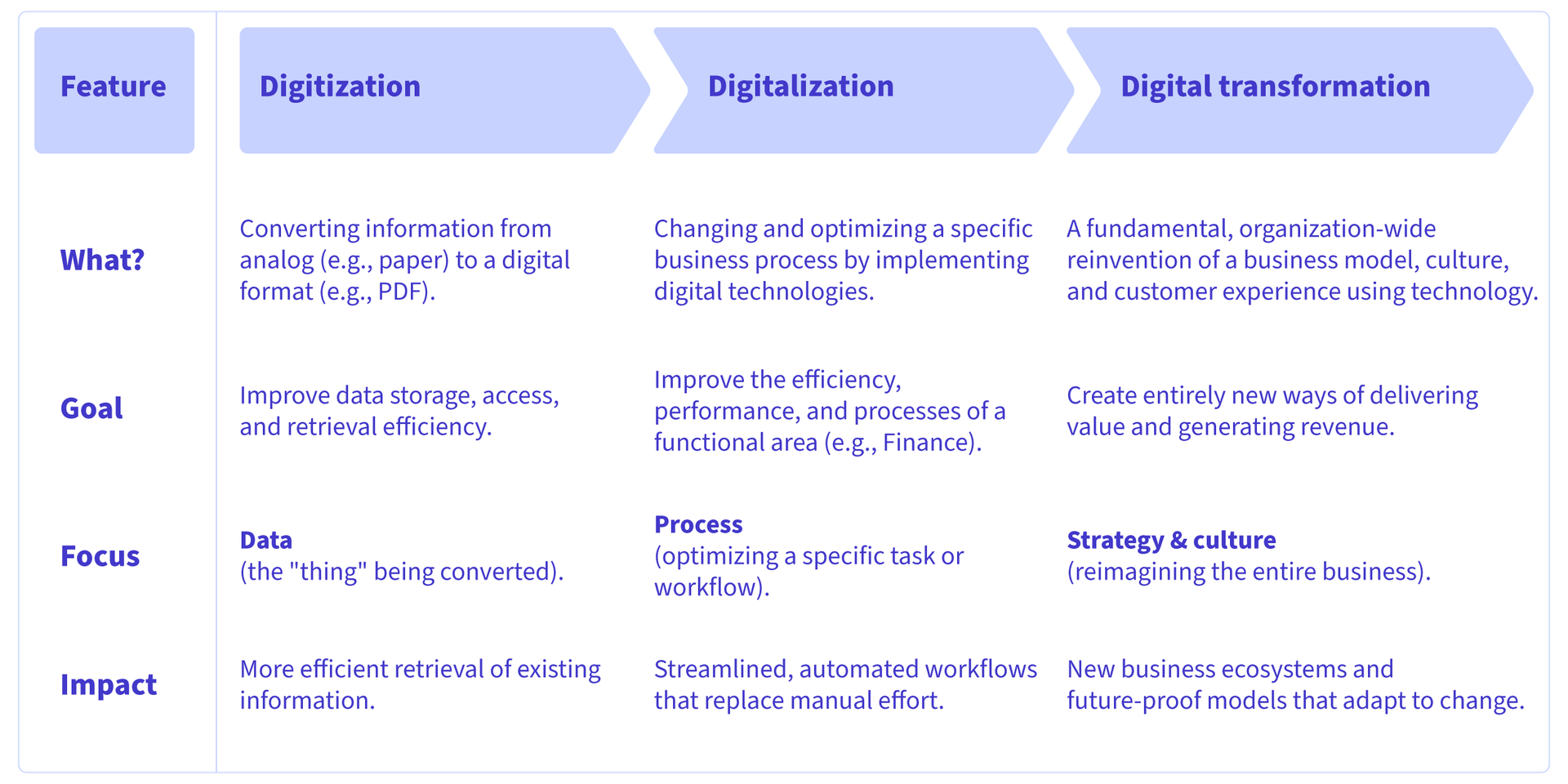
In short, digitization is the conversion of information from physical to digital form. For example, scanning a paper invoice and creating a PDF version.
In other words, digitization takes physical forms and converts them into electronic versions. This makes information easier and faster to find. Rather than searching through mountains of documents, you can simply search for the digital file on a computer.
Digitalization explained: process optimization
In short, digitalization means embracing digital technologies that impact work and business.
For example, digitalizing an invoice means making the entire invoicing process digital. Invoice creation, distribution, data extraction, and tracking are all carried out using digital technologies. The invoice can be automatically fed into and processed by different accounting systems, without any manual data input required.
To be a truly digital business, digitalization is required. This involves replacing manual processes with digital solutions. These solutions include automation software, integrated systems, and artificial intelligence.
Full digitalization enables businesses to implement processes and adopt digital technologies that can easily evolve and adapt to new ways of working. These technologies future-proof businesses and ultimately create more efficient, streamlined processes.
Digital transformation: The big picture
Digital transformation is the most expansive term, representing a strategic, organization-wide reinvention where digital technologies fundamentally reshape how businesses operate, deliver value, and engage customers. While, as we saw above, digitization converts paper/forms to digital files and digitalization automates individual processes (like e-invoicing), digital transformation asks: "How can technology enable entirely new ways of creating value?"
It goes beyond tactical improvements to completely redesign business models, culture, and customer experiences:
Digitization: Paper → PDF (data conversion)
Digitalization: PDF → automated e-invoice processing (process optimization)
Digital transformation: Individual processes → interconnected business ecosystems
A prime example: Finland's “Real-Time Economy” (RTE) shows how e-invoice digitalization evolves into full digital transformation, creating automated networks where invoices, receipts, payments, and reporting flow in real time across the entire economy. Digital transformation is the final destination, with digitization and digitalization as critical steps on the journey.
Comparison: at a glance
Getting started with digitalization
Although it may sound complicated, getting started with digitalization can be quick and easy.
Many businesses are adopting digital technologies to help automate their accounts payable (AP) and accounts receivable (AR) processes. These are two processes that traditionally require a lot of manual administrative work if digital technologies are not in place.
Interested in digitalizing your processes? Start with the basics and discover what it takes to digitalize your accounts and finance processes by reading our ‘What is e-invoicing?’ and ‘What is AP automation?’ blogs.
Subscribe to receive our monthly tax compliance newsletter, and follow us on LinkedIn for more updates on these business processes. Explore our compliant e-invoicing solutions today and connect with our local team to learn more.

Danielle Kiener
Lead Key Account Manager, Banqup Group
Danielle has 15 years of experience in customer relationship management within invoicing and financial administration. She currently works in Geneva, supporting global customers at Banqup Group and helping multinational companies digitise their processes. Over the years, she has been closely involved in the digital transformation of invoicing, including leading e-invoicing initiatives across the EMEA and Asia-Pacific regions for a major multinational. Her extensive experience means she’s always up to date on the latest e-invoicing regulations and changes around the world.